What the contemporary records say
The story takes an important turn in an Irish government document sent on the very day of the incident. A diplomatic communication, preserved in the National Archives of Ireland and published through the CAIN collection, reports McVeigh's attempted flight and states that a military sentry fired warning shots.
This matters. It establishes that the use of military gunfire was acknowledged in at least one contemporaneous state record. It does not, on its own, settle the dispute over the number of shots, where they were directed or whether O'Brien was in their line of fire.
Nor should that telex be confused with a Defence Forces ammunition return, an operational log or an after-action report. Those are distinct classes of record, and they deserve distinct questions.
“No reference was found”
In correspondence dated 7 June 2024, quoted in material provided for this investigation, Micheál Martin, then Tánaiste and Minister for Defence, reportedly advised Thomas Pringle TD that the Military Archives had searched their database and relevant files but found no reference to the incident.
“No reference was found in the files to the incident.”
The original correspondence should be published alongside this article once a copy can be checked. The reported outcome of a particular archive search does not mean that no government record exists anywhere. Indeed, the diplomatic telex demonstrates that at least one contemporaneous official record does exist.
That narrows and sharpens the question: what did the Military Archives search cover, and where are the military's own operational and ammunition records?
Five rounds cannot simply disappear
An army is not a collection of men who happen to own rifles. It is an institution of orders, accountability and record-keeping. Live ammunition is issued, carried, expended and reconciled according to procedures. Whether the records in this particular incident were created, retained, transferred, destroyed or misfiled is precisely what remains to be established.
It would be improper to conclude that documents were deliberately suppressed merely because a search was unsuccessful. It would be equally improper to treat that unsuccessful search as the end of the matter.
The questions Ireland should answer
- Who were the soldiers on duty, and who commanded them?
- What orders governed the use of live ammunition at Portlaoise?
- What weapons and ammunition were issued, and how many rounds were recorded as expended?
- Were incident reports, witness statements or after-action records prepared?
- Were prison management, Garda command and Army Headquarters informed?
- Which archives and record series were searched in 2024?
- If records were destroyed, when, on whose authority and under which retention schedule?
- Has any independent inquiry assessed O'Brien's account and the available footage?
Beyond the prison walls
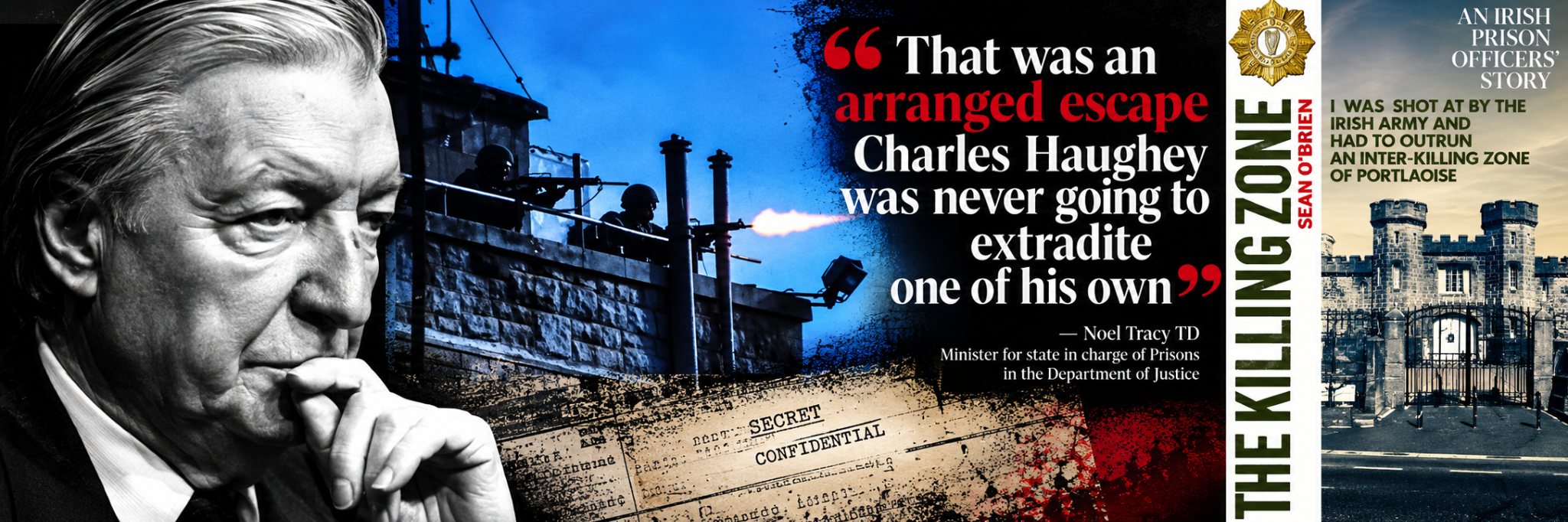
O'Brien has also raised allegations about the political background to the case, including suggestions concerning Charles Haughey and the extradition process. Such claims require independent corroboration. The quotations and imagined scenes used in promotional artwork are dramatisations, not authenticated instructions or government documents.
What is independently documented is that McVeigh's extradition became a matter of controversy in the British Parliament in June 1988, following a court ruling on identification evidence. The parliamentary record is available to readers below.
The footage survived
Thirty-eight years have passed. The video has been preserved. O'Brien has continued to ask questions. A government telex acknowledges shots, while the whereabouts of the complete military accounting remain uncertain.
A missing document is not itself proof of a conspiracy. But a known discharge of military ammunition should be capable of careful historical and institutional examination. The absence of answers should invite scrutiny, not silence.